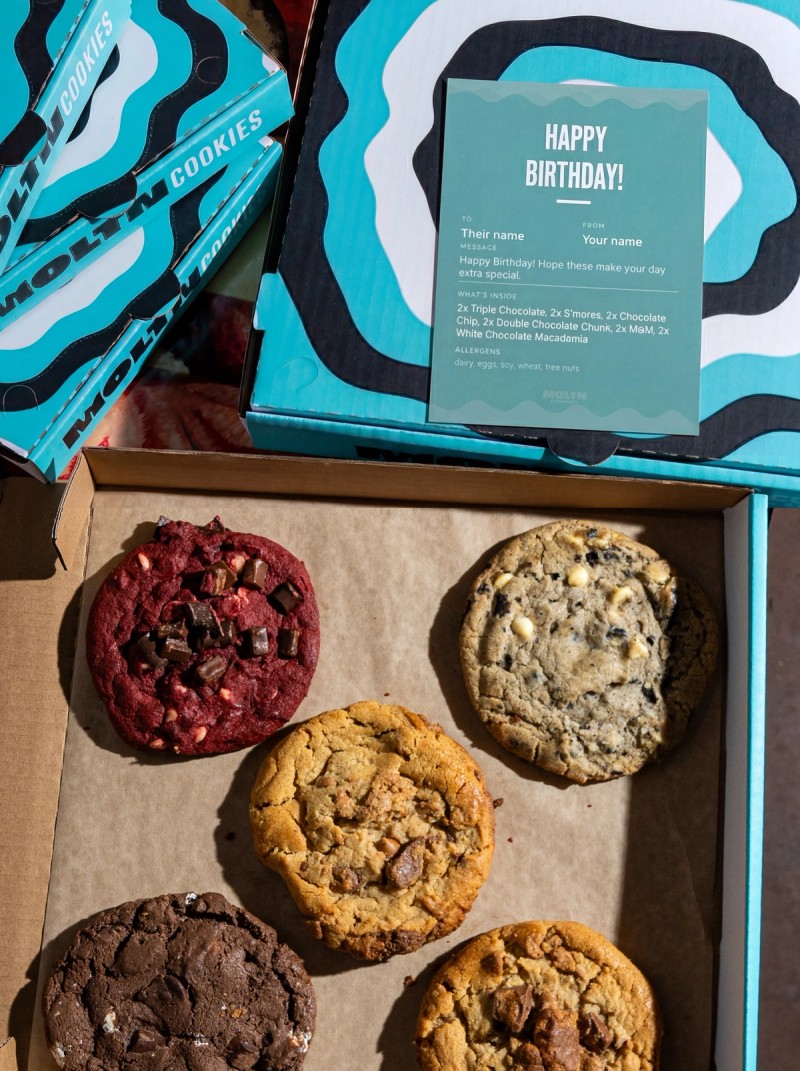
Pop quiz. You order cookies on a delivery app. They arrive 45 minutes later. The label says 'fresh baked.' The driver hands you a warm box. You open it. The cookies are soft. They're sweet. They're fine.
Are they really fresh? Almost certainly not. Are they really warm because they were freshly baked, or because they sat in a heated drawer for the last six hours? Almost certainly the second one. Once you understand the difference, you can't go back.
We bake cookies for a living. We've spent the last few years specifically trying to solve this problem, and the more we learned about how the rest of the industry handles delivery, the more we realized that the marketing language has quietly stretched the definition of 'fresh' so far that it doesn't really mean anything anymore. Here's what's actually going on.
The Warming Drawer Secret
Most large cookie delivery operations work the same way. They bake cookies in batches throughout the day, usually starting in the morning. After baking, those cookies go into a heated case or warming drawer where they sit at a temperature designed to keep them feeling warm to the touch.
When you place an order, your cookie is pulled from the warming drawer, packed up, and sent to you. By the time it arrives at your door, the cookie has been sitting in a heated case for somewhere between one and six hours, depending on when you ordered relative to the morning bake.
The label still says 'fresh baked.' The marketing still says 'warm.' Both are technically defensible. The cookie was baked. It is warm. But neither word is doing what most people think it's doing when they read them.
'Warm' is a temperature. 'Fresh' is a timestamp. They are not the same thing.
The Gooey Window
Here's the part that changes how you think about cookie delivery forever. A cookie has a window, and that window is short.
When a cookie comes out of the oven, the structure inside is still partially liquid. The butter is melted. The sugar hasn't fully crystallized. The starch hasn't yet retrograded into its firmer crystalline form. The result is the texture every cookie person is chasing: a gooey, slightly molten, slightly stretchy center surrounded by a barely-crisp edge.
That window lasts about 20 to 40 minutes after the cookie leaves the oven. After that, the cookie cools, the structure firms up, and the magic is gone. You can reheat the cookie later in a microwave or oven and the temperature will come back, but the texture will not. The starch has already retrograded. You can't reverse that with heat.
This is why a warming drawer doesn't work. It can keep a cookie warm. It cannot keep a cookie inside the gooey window. By minute 41, the cookie in the drawer is no longer the same product it was at minute 1, regardless of what temperature it's at.
Most delivery cookies you've ever had were 2 to 6 hours past that window before they ever left the kitchen.
The Four Things That Ruin a Delivery Cookie
Once you understand the gooey window, the four mistakes most cookie delivery operations make become obvious.
Mistake 1: Pre-baking in batches
Most cookie operations bake in the morning. They make a few hundred cookies in big trays, and those cookies sit on shelves or in warming cases for the rest of the day until somebody orders them. By the time the cookie reaches you at 8 PM, it might have been baked at 9 AM.
There are real economic reasons for this. Baking on demand requires more labor, more oven cycles, and more coordination. Batch baking is cheaper and easier. It's also the single biggest reason most delivery cookies aren't what they pretend to be.
Mistake 2: The Warming Drawer
To compensate for the fact that the cookies are no longer fresh, most operations put them in a warming drawer or heated case. This keeps them at a temperature that feels warm to the touch and lets the company describe them as 'warm' without lying outright.
The warming drawer doesn't restore a cooled cookie. It just keeps a cooled cookie warm. The texture is wrong, the center has long since solidified, and the bottom is usually slightly crispy from sitting on a heated surface for hours. The whole experience is a magic trick. Your hand says it's warm. Your tongue says something is off. You can't quite tell what.
Mistake 3: The Wrong Box
Cookie boxes are an underappreciated detail. Most cookie delivery operations use standard cardboard with a brand-friendly grease-resistant coating. Cardboard is not insulated. The cookies inside go from warm to room temperature in the first 10 to 15 minutes of transit.
Stacking matters too. Cookies stacked together lose heat through the seams. Cookies in single-layer compartments hold heat much longer. So does whether the box is sealed properly so the steam stays inside until you open it. These details cost about 15 to 50 cents per box, depending on volume. Most operations cut them. You can taste the corner cutting.
Mistake 4: Transit Time
Even if a cookie starts out perfect, every minute it spends in a delivery driver's car is a minute it cools. A 30 to 45 minute delivery window, which is normal on most apps, is enough to take a cookie from molten center to firm cookie.
This is why most 'warm cookie delivery' is, at best, a lukewarm cookie that was once warm. The math doesn't work unless the entire process is engineered to protect the heat window from the moment the cookie leaves the oven.
What a Real Warm Cookie Looks Like
If you've never had a cookie that was actually delivered warm, here's what to look for the next time you order one anywhere.
- The smell hits before you fully open the box. Aggressive butter and chocolate. Not a hint, an attack.
- The center gives when you bite it. A cooled cookie holds its shape. A real warm cookie has a center that's still slightly liquid, slightly stretchy, and noticeably softer than the edges.
- The edges are slightly crisp. Not crunchy, not hard. Just enough textural contrast to remind you this came out of an oven recently.
- You close your eyes on the first bite. It's an involuntary reflex. If you don't, the cookie wasn't warm enough.
- It feels like more than the sum of its ingredients. A great warm cookie is a bigger experience than the sugar and butter that went into it. That's the part you can't fake with a warming drawer.
If your delivery cookie doesn't do these things, it wasn't actually fresh. It was warm-adjacent.
The Buyer's Checklist
Whether you order from us or anyone else, here are the questions that separate real fresh-baked cookie delivery from warming-drawer theater.
- Is the cookie baked AFTER you place the order, or was it baked earlier today? This is the single most important question. If the answer is anything other than 'after you order,' the cookie isn't fresh. It might still be good. It isn't fresh.
- Are the cookies kept in a warming drawer or heated case at any point? If yes, the cookie has been outside the gooey window for at least an hour, probably longer.
- How long, on average, between the cookie leaving the oven and the cookie reaching your door? Anything over 60 to 90 minutes total means the texture window has closed.
- Are the cookies stacked in a single box, or in single-layer compartments? Stacked cookies lose heat fast. Single-layer holds it.
- Is the box insulated, or is it a standard cardboard box? Standard cardboard is decorative, not thermal.
- How long is the typical delivery window? Anything over 45 minutes is too long unless the entire process is built to compensate for it.
If the answers don't add up to 'baked after you ordered, no warming drawer, fast delivery in a real box,' you're getting a previously-warm cookie. Which is fine. Just know what you're buying.
How We Built It Differently
When we started MOLTN, we spent more time thinking about the delivery problem than we spent thinking about recipes. Recipes are easy. There are great cookie recipes everywhere on the internet. The hard part is getting them to your door in the right state.
Here's what we changed.
- No pre-baking, ever. When you place an order, that's when the oven starts. There is no inventory of pre-baked cookies sitting on a shelf somewhere waiting for an order. There is no morning bake to pull from. If nobody orders, nobody bakes.
- No warming drawer. We don't keep cookies warm. We bake cookies and immediately put them in the box and immediately send them out. The cookies don't sit anywhere except in the oven and in your hand.
- The box is the box. Insulated. Single-layer. Sealed. The 50 cents matters.
- 60 minutes oven-to-doorstep, typical. The whole process (order received, oven on, bake, box, deliver) is engineered to take less time than the cookie takes to cool. That's the actual product. Not the recipe. The clock.
That's it. That's the whole differentiator. Not a secret recipe. Not better chocolate. Just refusing to do the four things most cookie operations do because they're easier and cheaper.
The Bigger Point
Most things about food delivery are designed to feel good rather than be good. The pictures look better than the food. The labels say 'fresh' when nothing is. The 'warm' cookies are technically warm but missing the actual experience. None of this is a scandal. It's just how big delivery operations work, because the alternative is harder and more expensive.
But the harder, more expensive thing is also the only thing worth doing. A cookie isn't a commodity. It's a small, specific moment, and that moment only happens if the entire process is designed around protecting it. Anything else is, well, fine. But fine isn't what you actually wanted when you ordered cookies at 9 PM on a Tuesday. You wanted the moment.
That's what we make.
Other Ways MOLTN Shows Up
If this article was helpful, here are the other things we make. Cookies for yourself. Cookies as a gift. Cookies for the office (or the wedding, or the team retreat). And cookies as a business model for restaurant operators.
Order a Cookie That Was Actually Just Baked
No pre-baking. No warming drawer. No shortcuts. Same-day across DC, Northern Virginia, Maryland & Philadelphia.
Order Now →